
SimMS is a powerful engineering software designed for the simulation and analysis of Mechanical Seals. It offers advanced capabilities for modeling, simulating, and optimizing seal performance under various operating conditions. With its user-friendly interface and comprehensive features, SimMS enables engineers to improve seal design, reduce maintenance costs, and enhance overall system reliability.

PalAero provides high-precision computation of dynamic coefficients and stability analysis for gas-lubricated bearings. It is designed to help engineers optimize bearing performance, reduce energy consumption, and extend equipment lifespan. With its advanced algorithms and user-friendly interface, PalAero is an essential tool for professionals in the field of tribology.
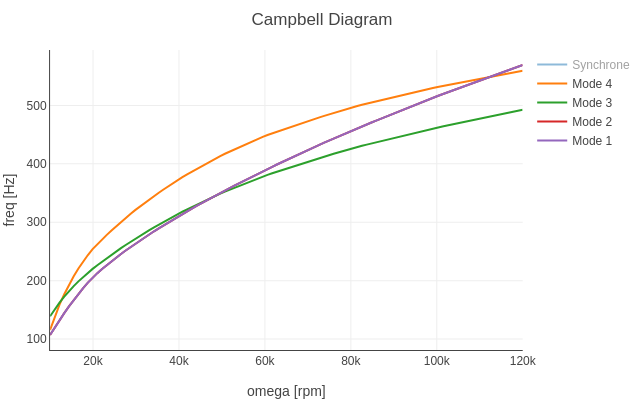
RDYN4 models the rigid-rotor dynamics of a four-degree-of-freedom system supported by two aerodynamic bearings. Bearing stiffness and damping coefficients vary with rotational speed and excitation frequency. The software provides Campbell and stability diagrams as well as unbalance response analysis.

TriboSolver - Dry Contact is a guided engineering workflow for analysing contact between unlubricated surfaces. Users can define material properties, loading and geometry, import supported measured surface data such as DATX, or generate a reproducible synthetic rough surface. The solver calculates pressure distributions, deformation and real contact area, with supported workflows for smooth and rough contacts, layered materials and subsurface stresses. Results can be inspected as maps and key scalar outputs, compared with suitable reference solutions, checked for convergence and exported in PDF or DOCX reports. The calculation runs locally in the TriboSolver 3.1 Windows desktop application, without requiring users to write solver code. Model assumptions and application-specific validation remain essential.
TriboSolver - Adhesion and Electroadhesion is a guided simulation family for exploring attractive interactions between contacting or closely separated surfaces. Users can build a contact case from material, geometry, loading and surface inputs, then select supported adhesion or electroadhesion laws independently to study their influence on the predicted interface forces. The workflow is suited to investigations in which roughness, local gaps, surface energy or an applied electrical potential affect adhesion. Calculations run locally in the TriboSolver 3.1 Windows desktop application and are presented through maps and numerical outputs that can be saved and reported. Results represent the assumptions of the selected mechanical, adhesive and electrical models; they are not a substitute for experimental characterisation or application-specific validation.
TriboSolver - Contact Temperature is a guided workflow for examining frictional heating and the predicted temperature response of two contacting bodies. Users define the contact geometry, loading, sliding conditions, friction model and thermal properties of both materials, including thermal conductivity, specific heat and density. The calculation combines contact and thermal inputs so engineers can explore how operating conditions and material choices influence the temperature field at a tribological interface. Inputs and results are handled within the TriboSolver 3.1 Windows desktop application, with local core calculations and project/report export. The result is an engineering estimate within the assumptions of the selected model and should be checked against suitable analytical, experimental or application-specific reference data.
TriboSolver - Mixed Lubrication is a guided simulation workflow for studying lubricated point and line contacts across full-film and mixed-lubrication conditions. Users define contact geometry, materials, loading, speed and lubricant properties, then inspect supported predictions of lubricant film behaviour and the sharing of load between the fluid film and solid-surface contact. The module is intended for exploring how operating conditions, surface interaction and lubricant response affect a tribological contact without requiring users to program a numerical solver. Core calculations run locally in the TriboSolver 3.1 Windows desktop application, and projects and results can be saved and exported. Predictions must be interpreted within the selected contact, rheology and surface-model assumptions and validated for the intended engineering application.
TriboSolver - Seizure is an engineering screening workflow for evaluating a configured thermal and adhesive transition threshold under selected contact, material, lubricant, loading and sliding conditions. It combines contact calculations with frictional heating and an adhesive-wear criterion so users can explore how changes in operating conditions may move a case toward or away from the chosen threshold. The workflow runs locally in the TriboSolver 3.1 Windows desktop application and supports structured input, calculation review and report export without requiring solver programming. The result is deliberately limited: it is not a universal prediction of seizure, scuffing or component failure. Thresholds, friction data and material behaviour must be chosen carefully and validated for the intended system.
TriboSolver - Wear is a guided workflow for exploring Archard-type wear in supported tribological contact cases. Users define the contacting materials, geometry, loading, motion and application-specific wear coefficients, then examine the predicted material removal within the chosen model. The workflow connects wear estimation to the local contact conditions calculated by TriboSolver and is intended for comparative studies, sensitivity analysis and engineering screening rather than universal lifetime prediction. Core calculations run locally in the TriboSolver 3.1 Windows desktop application, with projects and results available for local saving and report export. Because wear coefficients depend strongly on materials, surface state, lubrication and operating conditions, predictions should be calibrated and validated against relevant experiments or field data.
Annularis performs isothermal analysis of centered, eccentric, and misaligned annular seals operating with an incompressible fluid. Based on bulk-flow equations for operating regimes dominated by inertia forces, it evaluates leakage flow, forces, torques, and dynamic coefficients from inlet pressure, outlet pressure, inlet pressure loss, and outlet pressure recovery conditions.
ThrustPad calculates the behavior of a tilting pad thrust bearing lubricated with a liquid. Using rotational speed and axial load as operating conditions, it provides torques and dynamic coefficients for thrust bearing performance analysis.
CircuFlow computes the performance of a circular bearing operating with an incompressible liquid. From rotational speed and radial load inputs, it returns torques and dynamic coefficients for bearing analysis.
PivotPad analyzes a tilting pad journal bearing operating with an incompressible liquid. It uses rotational speed and radial load as operating conditions and delivers torques and dynamic coefficients.
RotorFlex computes the behavior of a flexible rotor using Bernoulli beam elements. With rotational speed, dynamic coefficients of bearings, thrust bearings, and annular seals, plus unbalance as operating conditions, it produces Campbell diagrams, stability diagrams, and unbalance response results.
FoilFlex analyzes a bump foil journal bearing with first-generation corrugated foils using a simplified Winkler foundation model with identical and uniformly distributed foil stiffness, including damping. Based on rotational speed, radial load, and unbalance, it computes the nonlinear response of the system.
AxiaBall computes a five-degree-of-freedom angular contact ball bearing model. Using rotational speed, radial load, and axial load as operating conditions, it returns radial and axial stiffness values.